
Why your food diary never told you anything
You logged every meal for a month. Your dietitian asked which foods your symptoms followed. You had no answer. That's not a you problem. Most food diaries are built in a way that can't answer the question.
1. It links by day, not by meal
A page per day, meals on top, symptoms at the bottom. It looks organised, and it's where the answer goes to hide. A symptom at 10 pm gets linked to breakfast, lunch and dinner at once. Over a month, good days and bad days show the same foods, because most days do. Nothing stands out because nothing can.
Link each symptom to the meal before it, with the gap between them. Most reactions people notice land in the hours after a meal, so the gap is the clue.
2. It blames everything
Say onion really is the one. Onion comes with garlic most of the time, so garlic shows up on every bad night too. In a diary that only lists what you ate, garlic looks exactly as guilty as onion, and so does the bread, and the wine, and the restaurant.
The way out is to look at each food on its own. Garlic on its own, with no onion in the meal: did anything follow? If not, it was riding along. Foods that only ever appear next to the real one drop out once you count them separately.
3. Nobody counts the meals without the food
This is the one almost every diary misses. "Bloating followed onion six times" sounds like a lot until you ask how often bloating followed everything else. If it followed half your meals anyway, onion isn't special. If it followed two meals out of 21 without onion, now you have something.
times you ate onion, bloating followed. Usually two to eight hours later.
Without onion, bloating followed two of 21 meals.
Enough to notice. Not a rule.Both halves, every time. A diary that only records the bad nights can only ever confirm what you already suspected.
What a count is, and isn't
A count like the one above is evidence you can check, meal by meal. It's enough to notice, and enough to bring to an appointment. It isn't a cause, and it isn't a rule. Sleep, stress and how much you ate show up in the gut too, which is why they belong in the diary alongside the food.
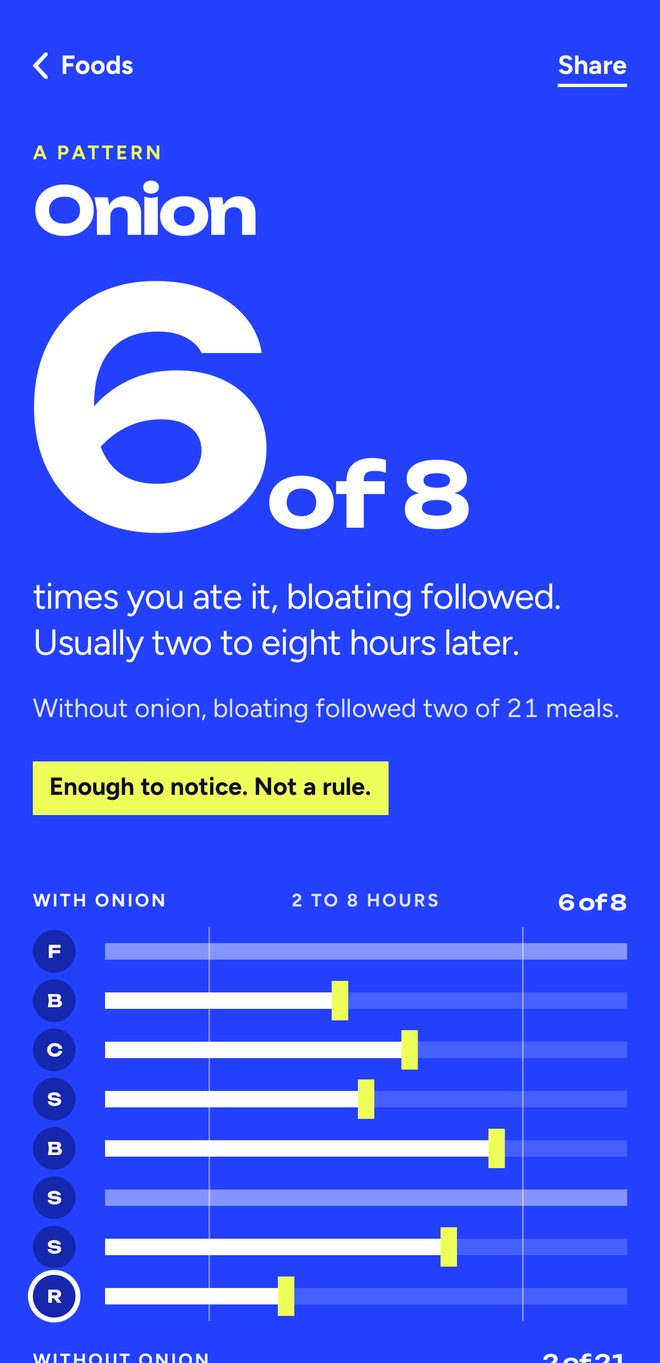
Sample diaryThe meals behind one line, each with its gap.
How to keep one that answers
- Log every meal, including the boring ones. The meals where nothing happened are what make the count mean something.
- Log symptoms with the time they started, and link each one to the meal before it.
- When you eat out, add what the dish usually has in it. The sauce is where foods hide.
- Mark the days where nothing happened. A clear day is data.
- Give it about two weeks before you read anything into it.
You can do all of this on paper, if you're willing to do the arithmetic at the end. Most people aren't, which is the point at which the notebook goes in a drawer.
Good questions
How long does a food diary take to show something?
About two weeks of logging every meal, for most people. A food needs to show up a handful of times, with and without a symptom following, before a count means anything. One week often isn't enough; a month of logging by day can be too much and still say nothing.
Paper or an app?
Either, as long as it links symptoms to meals, not days, and counts the meals without a food as well as the ones with it. Paper can do that if you add the arithmetic yourself. An app that does the counting saves the part most people give up on.
What if the diary says nothing?
That's a result. If no food lines up with your symptoms after two weeks of honest logging, the next question is probably not about one food, and that's worth telling your doctor or dietitian. Sleep, stress and meal size show up in the gut too.
Is a count the same as a cause?
No. A count says bloating followed onion 6 of 8 times and 2 of 21 times without it. That's enough to notice and bring to an appointment. It doesn't say why, and it isn't a reason to cut a food for good without talking to someone.
NutrUp does the counting.
A food and symptom diary for iPhone. Photograph what you eat, tap how you feel, and in about two weeks see which foods your symptoms followed, with the meals behind each one. No account, and the diary stays on your iPhone. What NutrUp is.
More guides: What to bring your dietitian What restaurant food often hides Which app for bloating All guides