
What app can help me figure out what's causing my bloating?
Short answer: a food and symptom diary that does the counting for you. Most don't. Here are the five things to check before you commit two weeks of logging to one, and how the apps people actually use measure up. We make one of them, and we've tried to be fair to the others.
The five things that matter
Bloating that follows food usually lands hours after the meal, not minutes. That delay is why a plain diary never answers: by the time you feel it, you've eaten twice more. An app earns its place by doing the arithmetic a notebook can't.
- It links a symptom to a meal, not a day. A day has three or four meals in it. Link the symptom to the day and every food you ate that day looks guilty, and good days and bad days end up with the same foods in them.
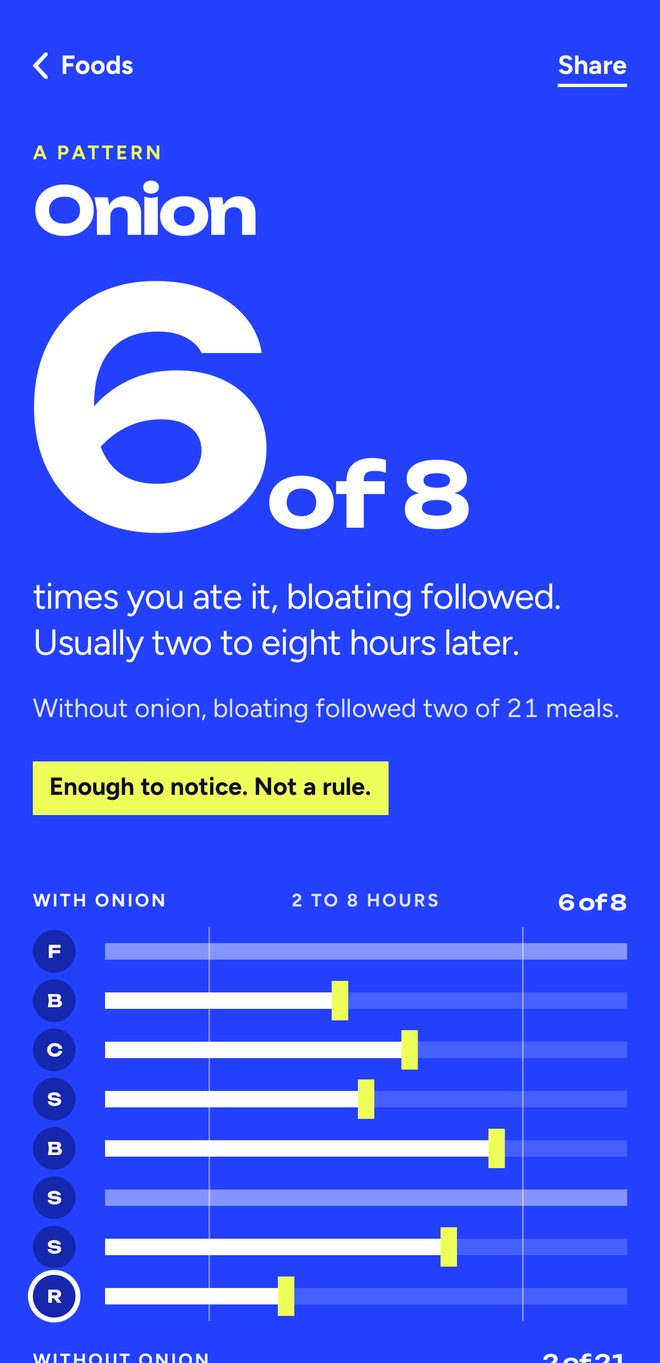
- It counts both halves. How often bloating followed a food, and how often it showed up when you didn't eat that food. Six of eight means something only next to two of twenty-one.
- Its window fits the food. If an app blames anything eaten in the last three days, nearly everything gets blamed. If it only looks at the last hour, it misses nearly everything. The useful window is somewhere in the hours after a meal, and it should be worked out from your own meals, not fixed in advance.
- It tells you what came up clear. Foods your symptoms never followed are the answer too. They narrow the list, and they stop you cutting things for no reason. A food that only rode along with the real one should drop out.
- You can take your data out. A CSV you can open, or at least a page you can hand to a dietitian. Two weeks of your meals shouldn't be locked in anyone's app, including ours.
times you ate onion, bloating followed. Usually two to eight hours later.
Without onion, bloating followed two of 21 meals.
That's the shape of an answer.How the options compare
Checked against each app's App Store page in October 2026. Prices are US, and the apps change, so treat this as a starting point and read the pages yourself.
Notebook or notes app
- By meal
- If you write the times
- Both counts
- If you do the arithmetic
- Window
- Your call
- Clear foods
- If you count them
- Your data
- It's yours
- Price
- Free
mySymptoms
- By meal
- Yes, with times
- Both counts
- Correlation report
- Window
- Set by you
- Clear foods
- Not as a list
- Your data
- PDF and CSV; account with cloud storage
- Price
- $9.99 a month or $59.99 a year after 7 days free; logging is free
Cara Care
- By meal
- Logs by entry
- Both counts
- Best and worst days view
- Window
- By day
- Clear foods
- No
- Your data
- Share with a doctor; dietitian program
- Price
- $89.99 program, 14 days free; last updated 2020
BellyCue
- By meal
- Yes
- Both counts
- Yes, over a 14-day test
- Window
- 2 to 72 hours, fixed
- Clear foods
- Yes, as a list
- Your data
- PDF on Pro; on the iPhone, no account
- Price
- $5.99 a month or $29.99 a year after 3 days free; new in July 2026
NutrUp
- By meal
- Yes, with the hours drawn
- Both counts
- Yes, on every finding
- Window
- Worked out per food from your meals
- Clear foods
- Yes, and foods that ride along drop out
- Your data
- CSV free forever, one page for the doctor on Pro; on the iPhone, no account
- Price
- $12.99 a month or $59.99 a year after a month free; logging and CSV are free
A notebook, or Notes
Free, and it works if you're disciplined about two things: write the time of every meal and the time every symptom started, and at the end of two weeks sit down and count. Most people do the first and never the second. If you'd rather do it on paper, this is the method.
mySymptoms
The one most people have tried, and the most complete diary of the lot: a big food database, barcode scanning, medication, sleep, stress, exercise, the Bristol scale, and charts for all of it. It has had years of updates and more than four thousand ratings. The analysis is a correlation report that you tune yourself, which suits people who like looking at charts and is a lot for people who just want a sentence. Your diary lives in an account, which means it syncs and can be shared with a clinic through their web app, and also means it's on their servers. Logging is free; the analysis is on the subscription.
Cara Care
A different kind of product: a 12-week program with a dietitian you can message, with a diary attached. If you want a person to read your diary and talk you through it, that's the pitch. The diary's own analysis is light, mostly a view of which foods were in your best and worst days, which is the by-day problem from the top of this page. The app's last update was in 2020, so check that it still runs on your iPhone before you start.
BellyCue
New this year, and close to ours on paper: a 14-day test, symptoms compared with and without each food, data on the phone, no account, a PDF for the doctor, and a lower price. Two things to know. Its window is a fixed 2 to 72 hours, so a symptom on Thursday can be laid at the door of Tuesday's lunch, which widens the net and blames more foods. And it hands you a "likely safe foods" list, a word we won't use, because a diary can only say a food came up clear in your meals so far. It has too few ratings yet for the App Store to show a score, which just means it's new.
NutrUp
Ours, so weigh this paragraph accordingly. You photograph the meal and tap how you feel, from the Lock Screen for eight hours after eating if you'd rather not open the app. Each food gets its own window, worked out from the hours that actually lined up for it in your meals, and each finding shows the count with and without the food and the meals behind it, drawn as lines. Foods that only came along with the real one drop out, and foods that came up clear are listed. When the photo can't show what's in a sauce, it asks what the dish usually has in it. The diary stays on the iPhone with no account. Logging, symptoms and CSV export are free for good; the findings, On this plate, trying a food again and the one-page report are on NutrUp Pro, with a month free first.
What it isn't: it's iPhone only, reading photos needs Apple Intelligence on iOS 27 (on other iPhones you type the dish), it costs more per year than BellyCue, and it says nothing about what any of it means for you. That's a doctor's job.
Sample diaryOne food's line, with the meals behind it.
Whichever you pick
- Log every meal for two weeks, including the boring ones. The meals where nothing happened are half the count.
- Log the time. A symptom at 11 pm says more about dinner than breakfast.
- When you eat out, add what the dish usually has in it. The sauce is where things hide.
- Take the result to a doctor or dietitian. One page is enough.
Good questions
How long does it take an app to find what my bloating follows?
About two weeks of logging every meal, including the ones where nothing happened. A food needs to show up several times with and without a symptom following before a count means anything. An app that gives you an answer after three days is guessing.
Can ChatGPT tell me what's causing my bloating?
It can explain what commonly causes bloating and it will usually tell you to see a doctor, which is right. It can't count your meals, because it hasn't seen them. The answer for you is in the pattern of what you ate and what followed, which takes a diary that does the counting.
Does a food diary app need my data on its servers?
No. The counting can run on the phone. Some apps keep your diary in an account so it syncs across devices or can be shared with a clinic; others keep it on the phone only and export a file when you want one. Both work. Decide which you'd rather have before you start logging, since moving a diary later is a chore.
When should I see a doctor instead of tracking?
If the bloating is new and severe, or comes with blood, weight loss you didn't intend, fever, or pain that wakes you at night, see a doctor first. A diary is for the long, ordinary kind that nobody has been able to pin down.
NutrUp does the counting.
A food and symptom diary for iPhone. Photograph what you eat, tap how you feel, and in about two weeks see which foods your symptoms followed, with the meals behind each one. No account, and the diary stays on your iPhone. What NutrUp is.
More guides: Why your food diary never told you anything What restaurant food often hides What to bring your dietitian All guides